How to Draw a Straw
Learn how to draw a straw in this step-by-step tutorial. Improve your drawing skills by practicing everyday objects. Create a realistic and detailed drawing with these easy-to-follow instructions.
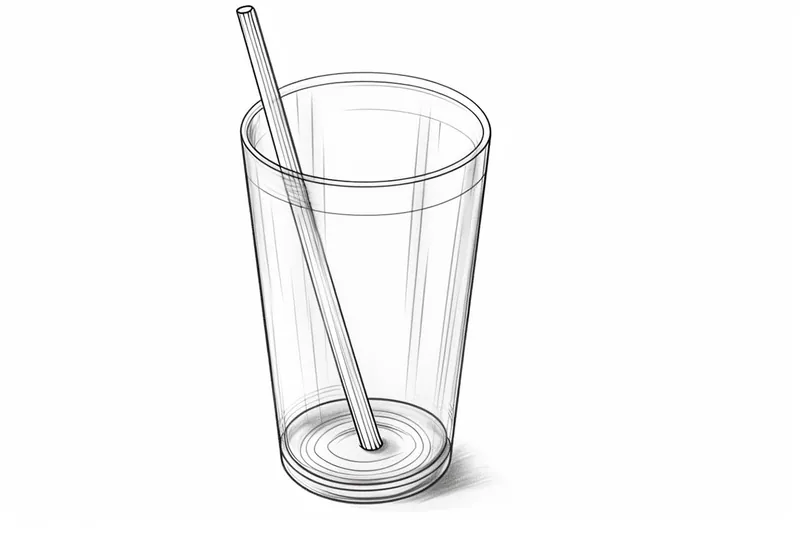
Materials You'll Need
- Pencil
- Paper
- Eraser
Everyday objects can often be overlooked as drawing subjects, but they offer unique opportunities to hone your artistic skills and sharpen your observation. Among these, the humble drinking straw stands out as a deceptively simple item that's present in countless settings, from bustling cafés to quiet kitchens. Learning how to draw a straw may seem straightforward at first glance, but it's an excellent exercise in mastering perspective, proportion, and shading. The straw's sleek cylindrical shape, gentle curves, and reflective surface make it a perfect subject to practice rendering three-dimensional forms and capturing subtle highlights and shadows.
Whether you're a beginner looking to improve your basic drawing techniques or a more experienced artist seeking to add realism to your still-life compositions, understanding how to draw a straw can help you develop greater control and precision in your artwork. This tutorial breaks down the process into simple, manageable steps, guiding you through sketching the basic outline, refining the form, and adding convincing details. Along the way, you'll explore techniques such as using light lines for construction, creating smooth curves, and adding depth with gradual shading.
By the end of this lesson, you'll not only have a realistic drawing of a straw, but also a stronger grasp of fundamental drawing skills that can be applied to a wide range of subjects. Remember, every artist starts with simple shapes and builds their confidence through practice. So grab your materials, follow along, and enjoy the process of bringing this everyday object to life—your journey to mastering how to draw a straw begins here!
Materials Required
Before we begin, make sure you have the following materials ready:
- Drawing paper: Use a high-quality paper that is suitable for your preferred drawing tools.
- Pencil: A mechanical pencil or a set of drawing pencils ranging from HB to 6B will work well.
- Eraser: Choose a soft eraser that won't damage the paper.
- Ruler: A straight ruler will help you with measuring and creating straight lines.
- Drawing pen: A pen with a fine tip or a marker can be used to add details and make your drawing stand out.
- Blending stump: A blending stump or a tortillon is useful for smudging and blending pencil marks.
Now that you have your materials ready, let's begin the drawing process.
Step 1: Sketch the Outline
Start by lightly sketching the basic shape of the straw. Draw a straight vertical line in the center of your paper, representing the main body of the straw. Feel free to use a ruler to ensure that the line is perfectly straight. Then, add a small oval shape at the top and bottom of the line to represent the openings of the straw.
Step 2: Add Thickness and Length
Using your ruler, draw two parallel lines on each side of the main body of the straw. These lines will add thickness to the straw and make it look more realistic. Extend the lines slightly beyond the top and bottom ovals to indicate the full length of the straw.
Step 3: Refine the Shape
Next, refine the shape of the straw by rounding the corners and edges. Smooth out the ends of the straw to make them look tapered and rounded. Take your time during this step to ensure that the proportions and curves of the straw are accurate.
Step 4: Add Details
Now it's time to add some details to make your drawing look more realistic. Start by drawing a thin line inside the top and bottom ovals to represent the inner diameter of the straw. Then, add a series of small curves along the main body of the straw to indicate its texture. These curves should be evenly spaced and follow the shape of the straw.
Tip: As you progress through the drawing steps, take frequent breaks to step back and view your work from a distance; this will help you assess the overall proportions and composition more effectively. Additionally, consider using a mirror to reflect your drawing, as it can reveal any asymmetries or mistakes that may not be obvious while looking directly at it. This practice can enhance your observational skills and contribute to a more polished final piece.
Step 5: Shade and Texture
To create depth and dimension in your drawing, it's important to add shading and texture. Begin by shading the areas where the straw overlaps itself or casts a shadow. Use light, horizontal strokes to gradually build up the shading, focusing on creating smooth transitions between light and dark areas.
Next, use your blending stump to smudge and blend the shaded areas, giving them a more realistic and soft appearance. Be mindful of the direction of the light source and adjust the shading accordingly.
Step 6: Finalize the Drawing
At this stage, take a step back and evaluate your drawing. Make any necessary adjustments to the proportions, shapes, or shading. Pay attention to small details such as highlights and reflections on the surface of the straw. These details can be added with a white pen or by erasing some of the shading to create the illusion of light reflecting off the straw.
Mistake Alert: One common mistake when drawing a straw is sketching it as a perfectly straight, flat cylinder without considering how perspective affects its shape—this often happens because our brains default to the simplest version of an object. If you draw both ends of the straw as straight lines, it can make the straw appear stiff and unrealistic. To avoid this, observe how the ends of the straw form gentle ellipses, especially when viewed from an angle, and notice any slight bends or curves along its length. Lightly block in these ellipses and curves before refining your lines, and check your drawing against your reference to make sure the straw feels three-dimensional and natural. This extra step will add a sense of depth and realism to your artwork!
Conclusion
Congratulations! You have successfully learned how to draw a straw. By following these step-by-step instructions and practicing regularly, you will continue to improve your drawing skills. Remember to be patient with yourself and have fun during the process. Keep exploring different everyday objects and challenging yourself to create realistic and detailed drawings.
Fun Facts About Straw
- The modern drinking straw was patented in 1888 by Marvin Stone, who wrapped paper around a pencil and glued it together.
- Plastic straws have become a major environmental concern, with millions ending up in oceans each year.
- Reusable straws made from materials like stainless steel, glass, and bamboo are gaining popularity for sustainability.
- Before paper and plastic, people used natural rye grass as straws, which is where the name "straw" originated.
- Some straws are designed with flexible "bendy" sections, invented in 1937 by Joseph Friedman.
- Straws have been found in ancient Sumerian tombs, where they were used for drinking beer over 5,000 years ago.
- Many fast food chains are phasing out single-use plastic straws in favor of paper or compostable alternatives.
- Some specialty straws, like bubble tea straws, are extra wide to accommodate tapioca pearls.
Suggestions for Scenes and Settings for Straw Drawings
- A close-up study of a single straw partially submerged in a glass of water, capturing the distortion and refraction of light.
- Several colorful straws fanned out in a mason jar, focusing on transparency and overlapping shapes.
- A crumpled, bent straw lying on a wooden table, emphasizing the play of shadow and reflective highlights.
- A straw with a flexible, accordion-style bend placed beside scattered ice cubes and condensation droplets.
- Multiple straws intertwined or knotted together, creating an abstract pattern of curves and lines.
- A straw poking out of a takeaway cup with a dome lid, surrounded by napkins and a receipt for a café scene.
- A cut straw with a sharp diagonal edge, placed next to a pair of scissorsand crafting materials.
- Straws arranged in a spiral or geometric pattern on a contrasting background for a graphical composition.
- A straw floating in a fizzy drink, with bubbles clinging to its surface and reflections on the liquid.
- An eco-friendly paper or bamboo straw next to its plastic counterpart, emphasizing texture and material differences.