How to Draw a Lionfish
Learn how to draw a lionfish in this step-by-step tutorial. Create a realistic and detailed representation of this magnificent marine creature.
Materials You'll Need
- Pencil
- Paper
- Eraser
The lionfish is one of the ocean's most striking and instantly recognizable inhabitants, famous for its bold stripes and dramatic, fan-like fins that ripple gracefully through the water. Native to the Indo-Pacific but now found in many warm ocean waters around the world, the lionfish is both admired for its beauty and noted for its role as an invasive species in some regions. Its unique appearance—with elongated fin rays, sharp spines, and intricate patterns—makes it a fascinating subject for artists who want to capture the elegance and complexity of marine life.
Learning how to draw a lionfish gives you the opportunity to practice a variety of drawing techniques, from sketching delicate lines to shading bold contrasts and rendering fine details. This subject is perfect for anyone looking to improve their skills in drawing textures, patterns, and fluid shapes. Whether you are an aspiring artist eager to expand your underwater portfolio, a student working on a marine biology project, or simply someone who loves sea creatures, drawing a lionfish can be both a rewarding and educational experience. The process will help you gain confidence in handling intricate shapes and overlapping elements, no matter your current skill level.
This step-by-step tutorial is designed to be accessible to beginners while also offering tips and techniques that more experienced artists will appreciate. By following along, you'll not only learn how to capture the distinctive look of the lionfish, but also enhance your overall drawing abilities. So gather your materials, take your time, and remember that every stroke brings you closer to mastering the art of drawing this captivating marine wonder. Let's dive in and discover how to draw a lionfish, transforming a blank sheet of paper into an impressive underwater masterpiece!
Tip: As you work through the steps of drawing a lionfish, consider using a light touch when sketching initial outlines to avoid making permanent marks that can be difficult to erase later. This approach allows for easier adjustments as you refine shapes and details, helping you capture the fluidity and grace of the lionfish's fins and body. Remember, gradual layering and building up details will enhance the overall depth and realism of your artwork.
Materials Required
Before we begin, let's gather the necessary materials for this drawing:
- Drawing paper
- Pencil (preferably a set of drawing pencils with varying degrees of hardness)
- Eraser
- Fine-tip markers or pens (optional, for inking)
- Colored pencils or markers (optional, for coloring)
Now that we have all the materials ready, let's get started on our lionfish drawing!
Step 1: Sketch the Basic Shape
Start by lightly sketching an oval shape for the lionfish's body. This will serve as a guideline for the overall proportions and position of the fish. Don't worry about making it perfect at this stage; we will refine the shape later.
Step 2: Add the Fins and Tail
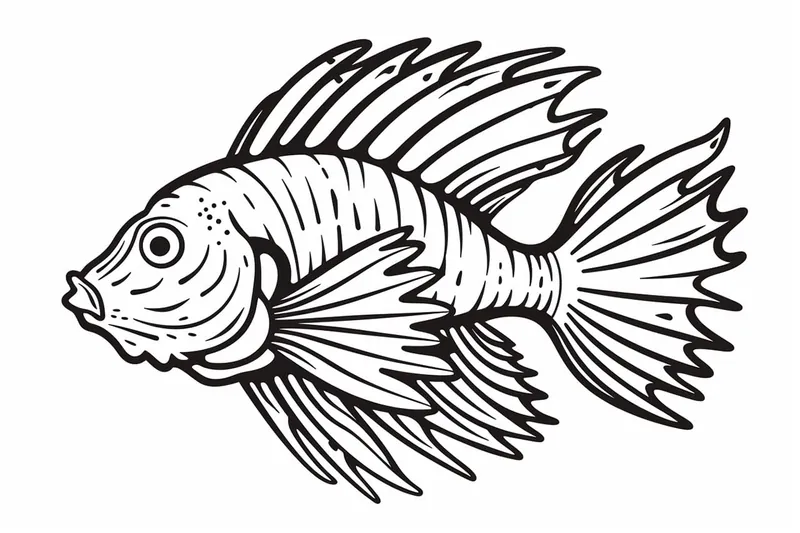
Next, add in the fins and tail of the lionfish. Use long, curved lines to represent the pectoral fins and the dorsal fin. The tail should be fan-shaped with long, flowing rays. Take your time and observe the reference images to ensure accuracy.
Step 3: Sketch the Facial Features
Now, let's focus on the lionfish's face. Draw a small circle for the eye and add a curved line for the mouth. The lionfish has a distinctive pattern of lines and dots on its face, so carefully sketch those details using short, curved lines.
Step 4: Refine the Body Shape
Go back to the body and refine the shape using your initial sketch as a guide. Add more curves and details to create a more rounded and textured appearance. Pay attention to the way the body curves and tapers toward the tail.
Step 5: Add the Fin Details
Now, let's work on the fins. Start with the pectoral fins and add the delicate, feathery texture using short, curved lines that extend from the base of each fin ray. The dorsal fin should have a spiky appearance, so use short, jagged lines to represent the fin rays.
Step 6: Define the Details
At this stage, it's time to add more details to our lionfish drawing. Use thin, light lines to outline the scales on the body and fins. Remember that lionfish have a series of colorful stripes and bands, so carefully sketch those patterns using reference images as a guide.
Step 7: Ink or Finalize Your Drawing
Once you are satisfied with your pencil sketch, you can finalize your drawing by inking over the lines with markers or pens. This step is optional but can add more definition and impact to your artwork. Use a fine-tip pen to carefully trace over the refined lines and details.
Step 8: Add Color (Optional)
If you prefer a colored lionfish drawing, you can use colored pencils or markers to add vibrant hues. These fish come in a variety of colors, so feel free to get creative with your color choices. Start by layering light colors and gradually build up the intensity and depth by adding darker shades.
Mistake Alert: A common mistake when drawing lionfish is making the fin rays too uniform and evenly spaced, which can cause your artwork to look stiff and unnatural. This often happens because it's tempting to quickly repeat the same line over and over, especially when faced with so many elongated spines and delicate fins. To avoid this, take a moment to study reference photos and notice how the fin rays vary in length, angle, and spacing—some overlap or curve slightly, creating a sense of movement and flow. Try lightly sketching the main fin shapes first, then add the rays with intentional variation, following the natural rhythm and direction you see in real lionfish. This approach will capture their unique, graceful appearance and bring your drawing to life!
Conclusion
Congratulations! You have successfully learned how to draw a lionfish. By following the step-by-step instructions and using the materials listed, you have created a detailed and realistic representation of this magnificent creature. Remember to practice and experiment with different techniques to further develop your drawing skills. Enjoy the process and keep creating!
Fun Facts About Lionfish
- Lionfish are native to the Indo-Pacific region but have become an invasive species in the Atlantic Ocean, causing ecological concerns.
- Their striking appearance comes from long, venomous spines that help protect them from predators.
- Lionfish can consume prey up to half their own body size due to their expandable stomachs.
- They have few natural predators in invaded areas, allowing their populations to grow rapidly.
- Lionfish can lay up to 2 million eggs per year, contributing to their rapid spread.
- Their venomous spines can cause painful stings in humans, but are rarely fatal.
- Lionfish use their large, fan-like pectoral fins to herd and trap small fish before eating them.
- They are popular in the aquarium trade due to their unique appearance, but require careful handling.
Suggestions for Scenes and Settings for Lionfish Drawings
- A lionfish gliding gracefully among vibrant coral reefs, surrounded by swaying sea anemones and colorful fish.
- Close-up study of a lionfish's elaborate fins and striped patterns, emphasizing texture and symmetry.
- A dramatic underwater scene where a lionfish is illuminated by shafts of sunlight filtering through the water's surface.
- A lionfish hunting for prey amid a rocky crevice, highlighting its stealth and predatory nature.
- Juxtapose a lionfish with invasive species warning signs or educational elements to explore its impact on marine ecosystems.
- A stylized composition inspired by Japanese art, featuring a lionfish surrounded by flowing water and abstract waves.
- [A lionfish camouflaged among seaweed and sponges](https://yonderoo.com/how-to-draw-a-sponge/), challenging the viewer to spot its intricate silhouette.
- Multiple lionfish interacting in a schooling display, showcasing their social behavior and overlapping fins.
- A lionfish viewed from above, fanning out its fins in a radial pattern for a striking geometric effect.
- An imaginative scene where a lionfish is the central character in an underwater fantasy world with mythical sea creatures.