How to Draw a Dragonfly
Learn how to draw a dragonfly with this step-by-step guide. Create your own masterpiece and capture the beauty of these delicate creatures.

Materials You'll Need
- Pencil
- Paper
- Eraser
Dragonflies are among nature's most fascinating insects, renowned for their slender bodies, transparent wings, and vibrant colors that shimmer in the sunlight. These agile flyers have captivated artists and nature lovers for centuries, symbolizing transformation, adaptability, and lightness of being across various cultures. Learning how to draw a dragonfly not only allows you to appreciate their intricate beauty up close, but also provides a fantastic opportunity to practice observational skills and attention to detail.
Whether you're drawn to dragonflies for their graceful forms, their symbolic meanings, or simply their striking appearance, adding them to your sketchbook can enhance your portfolio and bring a touch of elegance to your artwork. Many artists and hobbyists choose to draw dragonflies as part of nature studies, mixed media projects, or as standalone illustrations to decorate journals, greeting cards, and more. Their unique anatomy—with delicate veined wings and elongated bodies—offers both a delightful challenge and a rewarding subject for creative expression.
This tutorial on how to draw a dragonfly is designed for all skill levels, from beginners just starting out to experienced artists looking to refine their technique. You'll learn to break down the dragonfly's complex structure into simple shapes, gradually building up details and texture with easy-to-follow steps. Key techniques will include basic sketching, line refinement, and subtle shading to capture the transparency and iridescence of dragonfly wings. Along the way, you'll pick up useful tips for observing natural forms and translating them accurately onto paper.
Don't worry if you've never drawn an insect before—each step is explained clearly, ensuring you'll feel confident as you progress. Remember, every artist develops their own style with practice, so take your time and enjoy the process. By the end of this guide, you'll have created your own beautiful dragonfly illustration and developed new skills to apply to future drawings. Let's get started and discover the joy of capturing these extraordinary creatures on paper!
Materials Required
To create your dragonfly drawing, you will need the following materials:
- Drawing paper
- Pencil
- Fine tip black marker or pen
- Colored pencils or markers (optional)
Make sure you have these materials ready before you begin so that you can fully immerse yourself in the creative process.
Step 1: Head and Thorax
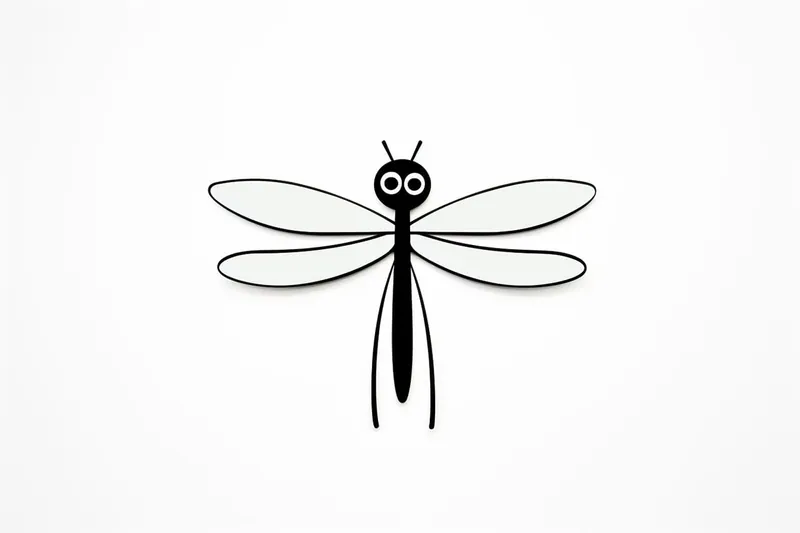
Start by drawing an oval shape for the dragonfly's head. This will be the central point of your drawing. Then, extend a slightly elongated and curved shape beneath the head for the thorax. The thorax should be narrower than the head and resemble a water drop shape.
Step 2: Eyes and Antennae
Within the head, draw two large compound eyes on either side. These eyes are usually round or oval in shape. Just above the eyes, add two thin, curved lines for the antennae. Dragonfly antennae are typically short and delicate.
Step 3: Wings
Extend two pairs of large, elongated wings from the thorax. Dragonfly wings are transparent and have a delicate veined pattern. To draw the wings, start by sketching the basic shape, and then add curved lines to represent the veins. Remember to make the wings symmetrical on both sides of the thorax.
Step 4: Add Details to Wings and Thorax
Tip: As you draw your dragonfly, take the time to observe real-life references or photographs of dragonflies to understand their proportions and details better. Pay close attention to the subtle curves of their bodies and the intricate veining patterns in their wings; this will help you capture their delicate beauty more accurately. Remember to use light strokes during your initial sketches, allowing for adjustments as you refine the details, ensuring your final illustration reflects the gracefulness of these fascinating insects.
Within the wings, add more intricate details by drawing smaller veins that connect to the main veins. These secondary veins should branch out and get thinner as they reach the wing's edges. Additionally, add a few curves and lines to the thorax to give it a more realistic appearance.
Step 5: Legs
Extend three pairs of legs from the lower part of the thorax. Dragonfly legs are long and delicate with small joints. Each leg should have two segments, with a thin and pointed end.
Step 6: Tail
At the end of the abdomen, draw two long and thin tails that curve outward. The tails consist of tiny segments that get thinner towards the end. Make sure the lengths of the tails are symmetrical and proportional to the rest of the dragonfly's body.
Step 7: Finalize the Outline
Now, using a fine tip black marker or pen, trace over the pencil lines to create a more defined and finished look. Start with the outline of the dragonfly's body, then move on to the wings, legs, and tails. Erase any unnecessary pencil marks and smudges.
Step 8: Coloring (optional)
If you wish to add color to your dragonfly drawing, you can use colored pencils or markers. Dragonflies come in a variety of vibrant hues, so feel free to get creative with your color choices. You can color the body in shades of blue, green, or even red. The wings can be lightly shaded to give a translucent effect.
Mistake Alert: A common mistake when drawing dragonflies is making their bodies too thick or rigid, which can make them look bulky and less graceful than they appear in nature. This often happens because it's tempting to exaggerate the body when sketching the basic shapes, or to use lines that are too heavy. To avoid this, observe reference photos and notice how the dragonfly's body is long, extremely slender, and tapers toward the tail. Use light, delicate strokes to map out the body, and remember to keep the segments narrow and gently curved for a more natural, airy feel. If you notice your dragonfly looks stiff or chunky, simply erase and redraw the body with a softer hand and a slightly curved gesture line to recapture its elegance.
Conclusion
Drawing a dragonfly allows you to appreciate the intricacies of its unique features while expressing your creativity. By following these step-by-step instructions, you can create a beautiful and lifelike representation of this marvelous creature. So grab your materials and dive into the world of dragonfly art!
Fun Facts About Dragonfly
- Dragonflies can fly at speeds of up to 35 miles per hour, making them some of the fastest insects in the world.
- There are over 3,000 known species of dragonflies worldwide.
- Dragonflies have been on Earth for more than 300 million years, predating dinosaurs.
- Their large compound eyes give them nearly 360-degree vision.
- Dragonfly larvae, called nymphs, live underwater for up to several years before becoming adults.
- They are expert hunters, catching and eating up to 95% of the prey they pursue.
- Dragonflies can move each of their four wings independently, allowing for impressive aerial maneuvers.
- Some species of dragonflies migrate thousands of miles, similar to birds.
Suggestions for Scenes and Settings for Dragonfly Drawings
- A dragonfly hovering above a tranquil pond, with its reflection mirrored in the water and lily pads floating nearby.
- A close-up view of a dragonfly perched delicately on a blooming wildflower, with dew drops glistening on its wings.
- Several dragonflies darting through tall reeds and grasses at sunset, their wings catching the golden light.
- A magical forest scene where a dragonfly is surrounded by glowing fireflies and soft, dappled moonlight.
- A dragonfly resting on a weathered branch over a babbling brook, with stones and moss in the background.
- A dramatic perspective of a dragonfly in flight, seen from below against a bright, cloud-dotted sky.
- A group of dragonflies dancing above a field of colorful wildflowers, with butterflies and bees joining the scene.
- A fantasy-inspired illustration with a jewel-toned dragonfly in an enchanted garden of oversized mushrooms and sparkling crystals.
- A scientific-style study with multiple dragonflies, each in a different pose, showing detailed anatomy and wing patterns.
- A serene Zen garden setting, with a single dragonfly resting on a smooth stone beside carefully raked sand patterns.