How to Draw a Square Pyramid
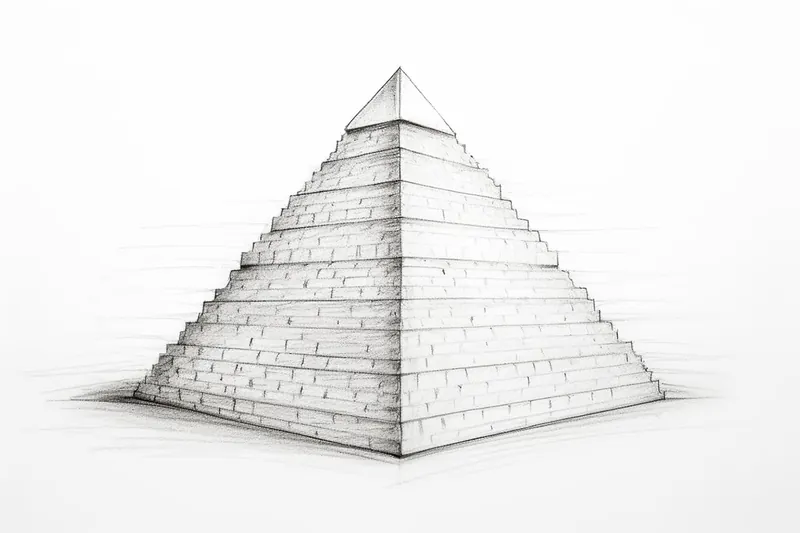
Learn how to draw a square pyramid in this step-by-step tutorial. Follow clear instructions to create a stunning three-dimensional pyramid drawing with just a few simple materials.
Materials You'll Need
- Pencil
- Paper
- Eraser
The square pyramid is a fascinating geometric form, instantly recognizable by its four triangular sides converging at a single apex and its square base anchoring it firmly to the ground. Often seen in architecture, mathematics, and even in nature, the square pyramid is a classic example of three-dimensional shapes that help us understand perspective, light, and shadow in art. Learning how to draw a square pyramid not only enhances your ability to represent three-dimensional objects on a flat surface, but also strengthens your foundational skills in geometry and spatial reasoning—qualities that are invaluable for artists of all levels.
Whether you're a student working on a math project, an aspiring architect, or simply an art enthusiast eager to expand your drawing repertoire, mastering the square pyramid is a rewarding challenge. Drawing this shape helps you practice accuracy with lines, symmetry, and perspective, and provides a perfect opportunity to experiment with shading and depth. This tutorial is designed for beginners and intermediate artists alike, breaking down the process into clear, manageable steps. You'll use basic tools like pencils, rulers, and erasers to ensure clean lines and precise angles while learning to visualize and sketch three-dimensional objects.
Don't worry if this is your first attempt—patience and practice are all you need to succeed. By the end of this guide, you'll not only know how to draw a square pyramid, but you'll also gain confidence in drawing other geometric structures. Grab your materials, get comfortable, and let's embark on this artistic journey together—your skills are about to reach new heights!
Materials Required:
- A blank sheet of paper
- Pencil
- Eraser
- Ruler
- Compass
Step 1: Draw the Base Square
Start by drawing a square shape in the center of your paper. Use a ruler to ensure that the sides are straight and the angles are right angles. The size of your square will determine the overall scale of your pyramid, so choose accordingly.
Step 2: Find the Center of the Square
Using your ruler, draw a line connecting the opposite corners of the square. This line will pass through the center of the square and help us find the apex of the pyramid later on.
Step 3: Draw the Height Line
From the center of the square, draw a vertical line extending upwards. This line represents the height of the pyramid and will determine its overall height and steepness.
Step 4: Connect the Apex to the Corners
Next, connect the apex of the pyramid (the top of the vertical line) to each of the four corners of the base square. These lines will form the triangular faces of the pyramid. Ensure that the lines are straight and meet at a point with the apex.
Step 5: Add the Base Edges
Now, draw lines connecting the corners of the base square. These lines will complete the base of the pyramid and give it a solid shape. Make sure these lines are parallel to the corresponding sides of the base square.
Step 6: Erase Unnecessary Guidelines
Once you have drawn the main structure of the pyramid, erase any unnecessary guidelines or construction lines that may still be visible. This will give your drawing a cleaner and more finished look.
Step 7: Add Details and Texture
To enhance the realism of your pyramid drawing, you can add details such as shading and texture. Use your pencil to create darker areas on the triangular faces to indicate shadow and depth. You can also add texture lines or patterns to the pyramid's base and sides to make it more visually attractive.
Tip: To effectively draw a square pyramid, start by sketching a perfect square for the base using a ruler to ensure straight lines and equal lengths. Once your base is laid out, find the center point by drawing two diagonal lines from opposite corners; this will serve as the apex's vertical reference. From this center, draw straight lines up to each corner of the square to form the triangular faces, keeping your pencil light so you can easily adjust if needed. As you refine your shapes, focus on maintaining symmetry and consider using a protractor to confirm your angles are correct. Finally, don't forget to practice shading to bring dimension to your pyramid—lightly shade one side to suggest light source direction, enhancing the three-dimensional effect!
Conclusion
Congratulations! You have successfully drawn a square pyramid. By following the step-by-step instructions in this tutorial, you were able to create a three-dimensional representation of a pyramid on paper. Drawing three-dimensional objects can be challenging, but with practice and patience, you can improve your skills and create even more complex geometric shapes. Continue to explore and experiment with different techniques to enhance your drawing abilities. Keep practicing, and soon you'll be amazed by what you can achieve!
Fun Facts About Square Pyramid
- The square pyramid has a square base and four triangular faces, making it a type of polyhedron.
- It is classified as a Johnson solid, specifically known as Johnson solid J1.
- The most famous square pyramids are the Pyramids of Giza in Egypt.
- Square pyramids have five vertices, eight edges, and five faces, as detailed in geometry resources.
- In mathematics, the volume of a square pyramid is calculated as (1/3) × base area × height.
- Square pyramids are used in architecture for their stability and aesthetic appeal, as seen in architectural history.
- The net of a square pyramid consists of one square and four triangles, which you can explore with interactive geometry tools.
- Square pyramids are often used in art to teach perspective and shading, as explained in art education resources.
- In nature, some crystals, like certain forms of pyrite, naturally form square pyramidal shapes.
- The square pyramid is a special case of the right pyramid, where the apex is directly above the center of the base.
Suggestions for Scenes and Settings for Square Pyramid Drawings
- Draw a futuristic city skyline where towering square pyramids serve as buildings with reflective glass sides.
- Illustrate a square pyramid partially buried in desert sands, reminiscent of an ancient archaeological site.
- Create a surreal landscape with floating square pyramids casting dramatic shadows over a checkerboard ground.
- Depict a group of square pyramids arranged as a modern outdoor sculpture garden in a park.
- Design a close-up, detailed study of a square pyramid made of crystal, emphasizing light refraction and reflections.
- Imagine a square pyramid as the centerpiece of a fantasy temple, surrounded by lush jungle vegetation.
- Show a square pyramid being constructed by tiny workers, with scaffolding and cranes demonstrating perspective.
- Draw a cross-section of a square pyramid to reveal hidden rooms, passageways, or treasure inside.
- Portray a square pyramid as a futuristic spaceship landing on an alien planet under a starry sky.
- Visualize a classroom scene where a teacher is using a large square pyramid model to explain geometry to students.