How to Draw a Railroad
Learn how to draw a railroad in this step-by-step tutorial. Capture the essence of a railroad and bring it to life on paper with these easy-to-follow instructions.
Materials You'll Need
- Pencil
- Paper
- Eraser
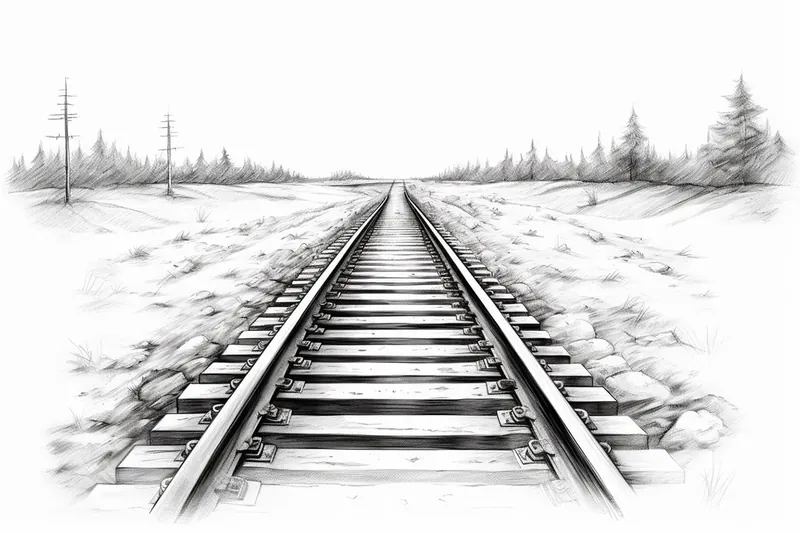
Railroads have long captured the imagination of artists and storytellers alike, symbolizing adventure, connection, and the spirit of exploration. Drawing a railroad allows you to explore perspective, depth, and geometry, making it a fascinating subject for both beginners and seasoned artists. Whether you're interested in creating vibrant landscapes, nostalgic travel scenes, or simply want to challenge yourself with a structured subject, learning how to draw a railroad offers a rewarding opportunity to expand your artistic skills. The iconic parallel tracks converging in the distance provide a perfect exercise in perspective drawing, helping you develop your ability to create the illusion of space and distance on paper.
In this tutorial, we'll break down the process of how to draw a railroad into easy-to-follow steps. You'll learn how to sketch the basic layout, add the rails and ties, and use shading to add dimension and realism. This subject is ideal for artists at any skill level—beginners will appreciate the clear structure and guidance, while more advanced artists can experiment with details like weathered wood, gravel textures, and surrounding landscapes. Drawing railroads is also a great way to practice working with vanishing points and linear perspective, which are essential techniques for creating dynamic and believable scenes.
No matter your experience, don't be afraid to make mistakes or try different approaches as you work through each step. With a bit of patience and practice, you'll soon be able to confidently draw a railroad that captures both its technical precision and its sense of adventure. Gather your drawing materials, get comfortable, and let's embark on this creative journey together!
Materials Required
Before we begin, let's gather the materials you'll need for this drawing:
- Pencil: Choose a graphite pencil with a medium hardness (HB or 2B) for sketching and shading.
- Eraser: Have a good quality eraser handy to correct mistakes and tidy up your drawing.
- Paper: Select a smooth and heavyweight paper that can handle pencil work without smudging or tearing.
- Ruler: A straight edge ruler or a T-square will help you draw straight lines for the tracks and other elements.
- Reference Image: Find a clear and detailed reference image of a railroad to guide your drawing. You can search for one online or use a photograph you have taken.
Now that you have all the necessary materials, let's dive into the steps for drawing a railroad!
Step 1: Plan Your Composition
Begin by studying your reference image and planning the composition of your drawing. Consider the perspective, focal points, and any additional elements you'd like to include, such as a train or landscape features. Sketch a rough outline of these elements lightly with your pencil, ensuring that the proportions and placement are accurate.
Step 2: Draw the Horizon Line
Next, draw a straight horizontal line across your paper to represent the horizon. This line will act as a reference point for the perspective of the railroad. Use your ruler or T-square to ensure the line is straight and level.
Step 3: Sketch the Tracks
Using your reference image as a guide, lightly sketch the railroad tracks. Start by drawing two parallel lines that taper into the distance, disappearing into a vanishing point on the horizon. Use your ruler to keep the lines straight and evenly spaced. Remember that the lines should appear closer together as they recede into the distance.
Step 4: Add Cross Ties and Rail Connectors
Draw small rectangles perpendicular to the tracks to represent the cross ties. These ties support the rails and help maintain their stability. Add details such as rail connectors at regular intervals along the tracks. These connectors join the sections of rail together.
Step 5: Develop the Surroundings
To create a realistic railroad, it's essential to add the surroundings. Begin by sketching the landscape or environment around the tracks. This could include fields, trees, buildings, or other structures. Pay attention to the perspective and scale to ensure a convincing composition.
Step 6: Shade the Tracks and Cross Ties
Now that the basic structure of the railroad is in place, it's time to add depth and dimension through shading. Use your pencil to gently shade the tracks and cross ties, starting with light strokes and gradually building up the darkness. Pay attention to the direction of light in your reference image and create subtle variations in shading to create a realistic effect.
Step 7: Add Details to the Railroad
To make your railroad drawing more intricate and authentic, focus on adding details. Sketch additional elements such as railroad switches, signals, and electrical poles. These details will enhance the overall realism and interest of your drawing.
Step 8: Refine the Surroundings
Spend some time refining and adding details to the surrounding landscape. Use various shading techniques to create texture and depth in trees, grass, or other elements. Pay attention to light and shadow to make your drawing more lifelike.
Step 9: Finalize the Drawing
Take a step back and evaluate your drawing as a whole. Make any necessary adjustments or corrections to ensure a balanced and visually appealing result. Once you're satisfied with your work, carefully erase any remaining pencil lines or smudges.
Tip: When drawing railroad tracks, start by establishing a strong vanishing point on your horizon line to create a convincing sense of depth. Use a ruler to draw the parallel lines of the tracks, ensuring they converge at this point, which will guide the viewer's eye into the distance. Sketch the cross ties (the wooden beams that hold the rails) at regular intervals, adjusting their lengths as they approach the vanishing point to enhance the illusion of perspective. For added realism, consider varying the width and texture of the ties, and incorporate shading to suggest the play of light and shadow. Finally, don't forget to add details like gravel and surrounding scenery to bring your railroad scene to life!
Conclusion
Congratulations! You've completed your drawing of a railroad following these step-by-step instructions. By paying attention to perspective, shading, and detail, you've successfully captured the essence of a railroad on paper. Remember, practice is key to improving your artistic skills, so keep exploring and experimenting with different subjects. Now, go grab your drawing supplies and embark on your next artistic adventure!
Fun Facts About Railroad
- The first public railway to use steam locomotives was the Stockton and Darlington Railway in England, which opened in 1825.
- The world's longest railway line is the Trans-Siberian Railway, stretching over 9,000 kilometers across Russia.
- Railroads played a crucial role in the expansion of the United States, connecting the east and west coasts in 1869.
- Japan's famous Shinkansen (bullet train) began operation in 1964 and revolutionized high-speed rail travel.
- The oldest operational steam locomotive is the Locomotion No. 1, built in 1825 and preserved in the UK.
- Railroad tracks are typically spaced 4 feet 8.5 inches apart, a measurement known as the standard gauge.
- Some of the world's steepest railways, like the Bernina Express in Switzerland, climb gradients of up to 7%.
- Modern freight trains can be over three miles long and carry thousands of tons of cargo.
- Railroads are among the most environmentally efficient modes of transportation.
Suggestions for Scenes and Settings for Railroad Drawings
- A lonely railroad track stretching into a misty forest at sunrise
- An old steam locomotive chugging through a snowy winter landscape mountain pass
- Railroad tracks crossing a vibrant autumn countryside with colorful trees
- An urban railroad bridge with graffiti, city buildings, and passing cars below
- A train station bustling with travelers, luggage, and vintage architecture
- Deserted tracks winding through an abandoned ghost town at sunset
- A dramatic overhead view of railroad tracks converging at a busy rail yard
- Railroad tracks curving along the edge of a river with reflections in the water
- Children playing near railroad tracks in a small rural village
- A futuristic high-speed rail line cutting through a sprawling cityscape