How to Draw a Bird Feather
Learn how to draw a bird feather in a step-by-step tutorial. This detailed guide will help you create a realistic and stunning feather drawing.
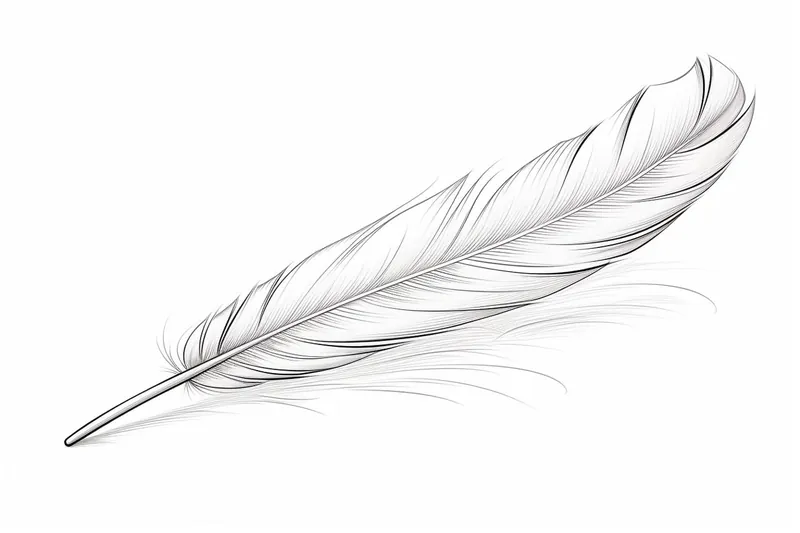
Materials You'll Need
- Pencil
- Paper
- Eraser
Bird feathers are not only intricate and delicate structures but also carry a rich symbolism and natural beauty that artists have admired for centuries. Capturing the fine details and textures of a feather can add a remarkable level of realism and elegance to your artwork. Whether you're aiming to enhance a nature-themed composition, practice detailed shading techniques, or simply expand your drawing skills, learning how to draw a bird feather is an excellent artistic exercise. Feathers vary greatly in shape, size, and pattern depending on the species, making each drawing a unique challenge that hones your observation and rendering skills.
This tutorial is designed for artists of all skill levels, from beginners eager to develop foundational drawing skills to experienced illustrators looking to refine their ability to depict natural forms with precision. The process involves mastering techniques such as careful line work to represent the feather's barbs, subtle shading to convey softness and volume, and attention to the central shaft or rachis that defines the feather's structure. By following this step-by-step guide, you will learn not only how to draw a bird feather but also how to observe and translate nature's delicate details into your art. Remember, patience and practice are key to capturing the feather's graceful elegance.
Embarking on this drawing journey will deepen your appreciation for the complexity of natural objects and boost your confidence in handling fine details. So, gather your materials, embrace the challenge, and enjoy the process of bringing a bird feather to life on paper. With dedication and guidance, you'll soon create stunning feather illustrations that showcase both your skill and creativity.
Materials Required
To draw a bird feather, you will only need a few essential materials:
- Pencil: Choose a pencil that suits your comfort and preference. A mechanical pencil with various lead sizes can be particularly handy for creating different types of strokes.
- Paper: Opt for a smooth and sturdy paper that can withstand erasing and shading. A sketchbook or drawing pad is a perfect choice.
- Eraser: Keep a good quality eraser handy to correct any mistakes or smudges.
- Fine-tipped pen or marker (optional): You can also use a fine-tipped pen or marker to outline or add details to your feather drawing.
Now that you have gathered your materials, let's dive into the step-by-step process of drawing a bird feather!
Step 1: Outline the Feather
Start by lightly sketching the outline of the feather using your pencil. Feathers come in various shapes and sizes, so you have the freedom to choose the type of feather you want to draw. Observe the feather carefully and pay attention to its overall shape and any unique characteristics it may have.
Step 2: Add the Shaft and Barbs
Next, draw the shaft of the feather. The shaft is the central part of the feather from which the barbs extend on either side. Extend the lines from the outline of the feather to create the shaft. Keep in mind that the shaft is not perfectly straight but has a slight curve to it.
Once the shaft is complete, add the barbs. Barbs are the smaller branches that attach to the shaft. Draw short, parallel lines extending from both sides of the shaft. The barbs should be evenly spaced and symmetrically arranged along the length of the shaft.
Step 3: Create the Barbs and Barbules
Now it's time to add more detail to the feather by drawing the barbs and barbules. Barbs are the individual strands that make up the barbules. Draw small, slanted lines along each barb, starting from the shaft and extending outward. The length and angle of the barbules can vary, giving the feather a realistic texture.
Step 4: Shade the Feather
To create depth and dimension, it's important to add shading to your feather drawing. Study the lighting conditions and determine the direction of the light source. Use your pencil to add light shading on one side of the feather and gradually darken the shading as you move away from the light source.
Blend the shading with a blending stump or your finger to achieve a smooth transition between light and dark areas. Take your time and build up the shading gradually, paying attention to the contours of the feather.
Step 5: Refine and Add Details
Now that you have the basic structure and shading of the feather, take a closer look and refine any areas that need improvement. Use your eraser to erase any stray lines or smudges. Add additional details such as smaller barbules, ligules, or any patterns or colors that may be present on the feather.
Conclusion
Drawing a bird feather can be a wonderful way to explore your artistic skills and appreciate the intricate beauty of nature. By following these step-by-step instructions, you can create a realistic and detailed feather drawing that will impress your friends and family. Remember to be patient and practice regularly to improve your drawing skills. So grab your pencil and paper, and let your creativity take flight!
Fun Facts About Bird Feather
- Feathers are made primarily of keratin, the same protein found in human hair and nails, providing both strength and flexibility.
- Birds have different types of feathers, including contour feathers for shape and flight feathers for flying efficiency.
- Feathers are waterproof due to the preen gland oil that birds spread over them, helping them stay dry and insulated.
- Some feathers can reflect ultraviolet light, which is visible to birds but invisible to humans, aiding in mate selection.
- Feathers grow from follicles in the skin and are periodically molted and replaced throughout a bird's life.
- Flight feathers have a unique asymmetrical shape that helps create lift and enable controlled flight.
- Feathers have inspired human technology, including lightweight materials and aerodynamic designs.
- Down feathers provide excellent insulation by trapping air close to the bird's body, keeping it warm in cold climates.
Suggestions for Scenes and Settings for Bird Feather Drawings
- A single, large feather floating gently on a calm pond surface with soft ripples around it.
- A close-up of a bird feather caught in early morning dew, with tiny water droplets reflecting light.
- A collection of various feathers arranged artistically on a rustic wooden table with natural light casting shadows.
- A feather embedded in a patch of moss and wildflowers in a forest floor setting, showing contrast between textures.
- A feather drifting through the air against a vibrant sunset sky, capturing movement and color gradients.
- A detailed study of a peacock feather with its iridescent eyespots set against a dark velvet background to highlight colors.
- A feather lying beside vintage writing tools like an ink bottle and quill pen, evoking a historical or poetic atmosphere.
- A feather caught in a gentle breeze among tall grasses in an open meadow, emphasizing natural flow and lightness.
- An abstract composition of overlapping feathers from different bird species showcasing diverse patterns and textures.
- A feather resting on aged parchment paper with faint sketches of birds and botanical elements around it.