How to Draw a 3D Square
Learn how to draw a 3D square with this step-by-step drawing tutorial. Add depth and dimension to your artwork using simple techniques. Perfect for all skill levels.
Materials You'll Need
- Pencil
- Paper
- Eraser
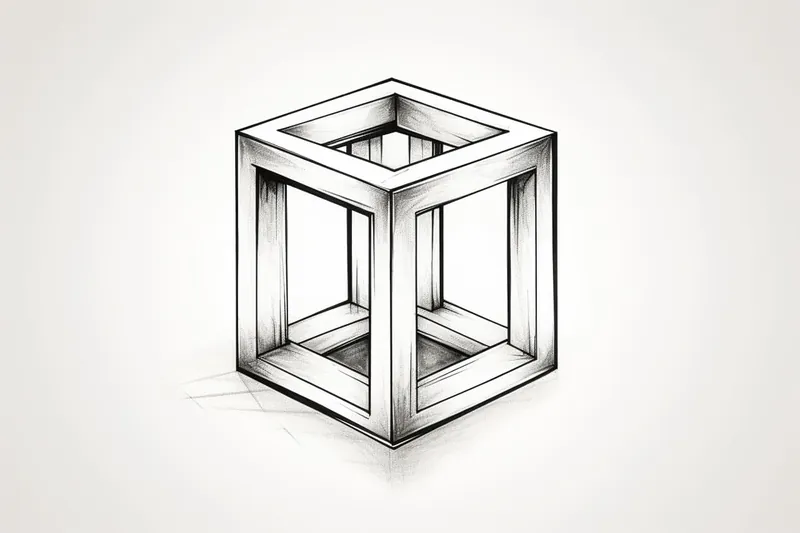
Welcome to this comprehensive tutorial on how to draw a 3d square, an essential skill for anyone interested in enhancing their understanding of perspective and spatial relationships in art. A 3D square, often referred to as a cube, is a fundamental geometric shape that appears frequently in both natural and man-made environments. Mastering the ability to depict this shape with accurate depth and dimension not only strengthens your technical drawing skills but also lays the groundwork for tackling more complex forms and compositions in your artwork.
Learning how to draw a 3d square is particularly beneficial for artists at all skill levels—from beginners eager to grasp the basics of three-dimensional drawing to intermediate artists looking to refine their shading and line work techniques. This tutorial will guide you through a step-by-step process, focusing on key concepts such as vanishing points, light sources, and proportions to create a realistic representation. We will explore simple construction methods, ensuring that you can confidently create convincing 3D shapes without feeling overwhelmed by complicated instructions.
By the end of this tutorial, you will have not only drawn a convincing 3D square but also gained valuable insights into spatial visualization and perspective drawing. Remember, practice is the key to improvement, and each step you take builds your artistic confidence and skill. So grab your pencils and paper, and let's embark on this creative journey together—your mastery of three-dimensional shapes awaits!
Materials Required
Before we begin, let's gather the materials you'll need for this drawing tutorial:
- Paper: Choose a smooth-surface paper that works well with pencils or your preferred drawing medium.
- Pencils: You'll need a range of pencils with different lead hardness, such as HB, 2B, 4B, and 6B.
- Eraser: Get a good-quality eraser that can easily remove any mistakes without damaging the paper.
- Ruler: A straight-edged ruler will help you maintain the precision of your lines.
- Optional: If you prefer, you can also use a compass to achieve accurate curves while drawing the square.
Now that we have our materials ready, let's explore the step-by-step process of drawing a 3D square.
Step 1: Start with the Base Square
To begin, draw a square using your ruler. Make sure to use light and loose lines so that you can easily erase and adjust later if needed. The size of the square is up to you, but for this tutorial, let's start with a medium-sized square. You can use any pencil hardness for this initial sketch.
Step 2: Add Depth with Guidelines
Now, let's add guidelines to create the illusion of depth in our square. Draw diagonal lines from the corners of your square, meeting at a central point. These lines will serve as a guide for the 3D effect. Use a light pencil, such as an HB or 2B, to draw these lines, as they will be erased later.
Step 3: Define the Sides of the Cube
Next, it's time to define the sides of the cube. Draw vertical lines extending from the corners of the base square to create the sides of the cube. Ensure that these lines are parallel to each other and aligned with the guidelines you drew in the previous step. Make the sides of the cube slightly shorter than the base square to create the illusion of depth.
Step 4: Create the Top Face of the Cube
Now, let's draw the top face of the cube. Connect the top ends of the vertical lines you drew in the previous step with horizontal lines. These lines should be parallel to the base square and aligned with the guidelines. Take your time to make sure the lines are straight and evenly spaced.
Step 5: Add Details to the Cube
To make your 3D square look more realistic, add details such as shading and texture. Start by adding shading to one side of the cube to create a sense of volume. Use a softer pencil, like a 4B or 6B, and apply more pressure to create darker tones. Gradually blend the shading with a blending stump or your finger to achieve a smooth transition.
Step 6: Refine the Cube
Now that the basic structure of your 3D square is complete, it's time to refine the details. Use an eraser to remove any unnecessary or overlapping lines, especially the guidelines and initial sketch. Pay attention to any areas that need adjustment or correction, and make the necessary changes to perfect your drawing.
Conclusion
Congratulations! You have successfully learned how to draw a 3D square. By following these step-by-step instructions, you can create a realistic and visually appealing square with depth and dimension. Remember, practice makes perfect, so don't be discouraged if your first attempt doesn't turn out exactly as expected. Keep honing your skills, experimenting with different shading techniques, and soon you'll be able to draw 3D squares effortlessly.
We hope you found this tutorial helpful and enjoyable. Happy drawing!
Fun Facts About 3D Square
- The 3D square, commonly known as a cube, is one of the five Platonic solids, which are convex polyhedra with identical faces and angles.
- In geometry, a cube has 6 faces, 12 edges, and 8 vertices, making it a fundamental shape in spatial reasoning.
- Drawing a 3D square helps artists understand perspective, especially the use of vanishing points to create depth.
- The cube is widely used in computer graphics and 3D modeling as a basic building block for more complex shapes.
- In art, mastering the 3D square is essential for creating realistic objects and environments, as it trains the eye to see volume and space.
- The cube has symbolic meanings in various cultures, often representing stability, honesty, and groundedness.
- Mathematically, the volume of a cube is calculated by cubing the length of one of its sides (V = a³).
Suggestions for Scenes and Settings for 3D Square Drawings
- A futuristic cityscape with 3D squares as the main architectural elements, showcasing varying sizes and perspectives.
- A still life composition featuring everyday objects transformed into 3D cubes, such as a cube-shaped fruit bowl or cube-stacked books.
- An abstract geometric art piece where multiple 3D squares intersect and overlap in a complex pattern with varying shades and textures.
- A game board setting where the playing pieces and board itself are constructed from 3D squares, emphasizing perspective and depth.
- A nature-inspired scene where 3D squares appear as floating platforms or stepping stones over a calm lake or forest floor.
- A surreal scene with 3D squares morphing into organic shapes, blending geometry with natural forms like leaves or crystals.
- A minimalist interior room design highlighting furniture and decor made entirely of 3D square shapes, focusing on light and shadow.
- A mechanical or robotic theme where 3D squares form parts of a machine or robot, demonstrating complex spatial relationships.
- An outer space environment with floating 3D squares as futuristic satellites or space stations, using dramatic lighting effects.
- A playful children's playground made up of colorful 3D cubes arranged in creative and imaginative ways.