How to Draw a Flower of Life
Learn how to draw a Flower of Life, a beautiful and intricate geometric pattern, with step-by-step instructions in this art tutorial.
Materials You'll Need
- Pencil
- Paper
- Eraser
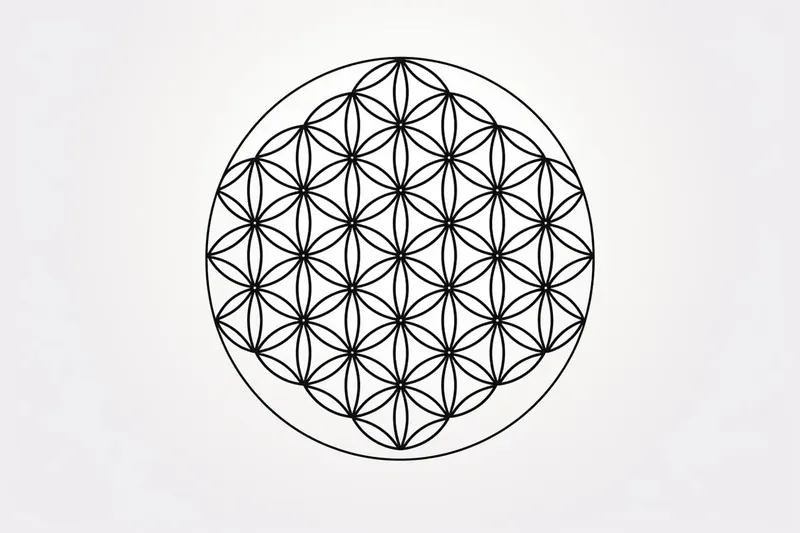
The Flower of Life is one of the most recognizable and meaningful symbols found in sacred geometry. Its distinctive design consists of evenly spaced, overlapping circles arranged in a harmonious pattern, forming an intricate network of petals and shapes. This timeless motif has appeared in the art, architecture, and spiritual iconography of many cultures throughout history, from ancient Egyptian temples to Renaissance artworks. Believed by some to represent the fundamental forms of space and time, the Flower of Life holds a special allure for artists, mathematicians, and anyone drawn to the beauty of geometric patterns.
Learning how to draw a Flower of Life can be a deeply rewarding experience, whether you're interested in exploring sacred geometry, enhancing your drawing skills, or simply creating a visually stunning piece of art. This symbol is not only aesthetically pleasing but also carries a sense of balance and harmony that can be meditative to replicate. Many artists use the Flower of Life as a foundation for more complex mandalas or to add a spiritual dimension to their work. Drawing this pattern can also be a wonderful way to practice precision, patience, and focus, making it a valuable exercise for artists of all skill levels.
In this tutorial, we'll break down the process of how to draw a flower of life into easy-to-follow steps, so you can create your own version of this captivating design. You'll learn how to use basic tools like a compass and ruler to achieve perfect symmetry, and we'll offer tips on keeping your circles neat and evenly spaced. Whether you're a beginner who's just starting to explore geometric drawing or a more experienced artist looking to refine your technique, this guide is designed to help you succeed. Along the way, you'll develop a deeper appreciation for the mathematical elegance and spiritual significance behind the Flower of Life.
So, gather your drawing supplies and get ready to embark on a creative journey! With a bit of patience and practice, you'll soon master how to draw a Flower of Life and discover just how enjoyable and satisfying it can be to bring this ancient symbol to life on paper. Remember, every artist's interpretation is unique, so don't hesitate to add your own flair as you follow along. Let's begin and see where your creativity takes you!
Materials Required
Before we begin, make sure you have the following materials ready:
- A piece of paper or a sketchbook
- Pencil
- Ruler or compass
- Eraser
Now that we have our materials ready, let's jump into the steps of drawing the Flower of Life.
Step 1: Start with a Circle
Begin by drawing a large circle in the center of your paper. This will be the foundation of your Flower of Life. Use your compass or a circular object as a guide to create a perfect circle. Take your time to ensure it is as round and symmetrical as possible.
Step 2: Create Six Additional Circles
Using the same radius as your large circle, draw six smaller circles around the central circle, evenly spaced. These circles should intersect with the central circle, creating a flower-like shape. Again, try to make them as symmetrical as possible.
Step 3: Add More Circles
Next, draw three more circles within each of the six smaller circles. The new circles should be the same size as the smallest circles you drew in the previous step. Make sure these circles are evenly spaced within their respective larger circles and intersect with the neighboring circles.
Step 4: Complete the Flower of Life
To complete the Flower of Life, continue adding more circles within each of the existing circles. Repeat this process until you have a total of 19 circles in the pattern. Each circle should be the same size and evenly spaced within its neighboring circles. As you add more circles, the pattern will become more intricate and detailed.
Step 5: Refine the Drawing
Once you have drawn the basic structure of the Flower of Life, take a moment to refine and clean up your drawing. Use your ruler to ensure that all the lines are straight and the circles are perfectly round. Make any necessary adjustments or corrections using your eraser.
Step 6: Add Shading (Optional)
If you want to add some depth and dimension to your drawing, you can experiment with shading. Choose a light source and shade the areas where the circles overlap, creating a sense of depth. You can use hatching or cross-hatching techniques to achieve this effect. Don't be afraid to experiment and find a shading style that you like.
Tip: For crisp, precise circles in your Flower of Life, always use a sharp pencil and a well-calibrated compass—set the compass point firmly at the center and double-check the radius before drawing each circle. Work lightly at first, so you can easily erase and adjust as needed without leaving marks. As you build the pattern, rotate your paper rather than your compass hand to maintain consistent pressure and line quality all the way around. Taking your time with these foundational steps will ensure your overlapping circles align perfectly, making the final pattern harmonious and visually satisfying.
Conclusion
Drawing the Flower of Life may seem complex at first, but with patience and practice, you can master this beautiful geometric pattern. By following the step-by-step instructions outlined in this article, you'll be able to create your own Flower of Life artwork. Remember to take your time, be precise, and have fun with the process. The more you practice, the better you'll become.
So grab your materials and start drawing your very own Flower of Life today!
Fun Facts About Flower of Life
- [The Flower of Life is a geometric pattern made up of evenly spaced, overlapping circles, and is considered a key symbol in sacred geometry](https://www.britannica.com/topic/sacred-geometry).
- Ancient examples of the Flower of Life can be found in the Temple of Osiris at Abydos, Egypt, dating back thousands of years.
- Some believe the Flower of Life contains the blueprint for all creation, including the so-called "Seed of Life" and "Fruit of Life" patterns.
- The symbol has appeared in various cultures worldwide, including Chinese, Indian, and medieval European art, according to Learn Religions.
- Leonardo da Vinci studied the Flower of Life and its mathematical properties, incorporating its geometry into his art and sketches.
- Many people use the Flower of Life as a meditative tool, believing it promotes harmony and spiritual growth.
- The pattern is said to represent the interconnectedness of all life and the fundamental forms of space and time.
- Modern artists and designers often use the Flower of Life as inspiration for mandalas, jewelry, and architecture.
Suggestions for Scenes and Settings for Flower of Life Drawings
- Draw the Flower of Life pattern emerging from the sands in front of an ancient Egyptian temple, blending the geometry with hieroglyphs and palm trees.
- Incorporate the Flower of Life as a stained glass window in a sun-drenched Renaissance cathedral, with colored light casting intricate patterns on the stone floor.
- Illustrate the Flower of Life pattern floating above a tranquil forest clearing at dawn, surrounded by mist and illuminated by soft golden sunlight.
- Use the Flower of Life as the focal point of a cosmic scene, with stars, galaxies, and nebulae weaving through and around the geometric design.
- Create an underwater scene where the Flower of Life is formed by overlapping bubbles, with fish and aquatic plants weaving through the circles.
- Integrate the Flower of Life into a mandala, adding layers of natural elements such as leaves, petals, and crystals radiating outward from the center.
- Imagine the pattern etched into the surface of a serene mountain lake, reflecting the sky and surrounded by pine trees and snow-capped peaks.
- Depict the Flower of Life as a luminous portal in a mystical landscape, with magical creatures or ancient guardians nearby.
- Combine the Flower of Life with technological elements, such as circuit patterns or futuristic cityscapes, to explore the intersection of nature and innovation.
- Show the Flower of Life drawn in chalk on a busy urban sidewalk, with people pausing to admire or interact with the artwork.